
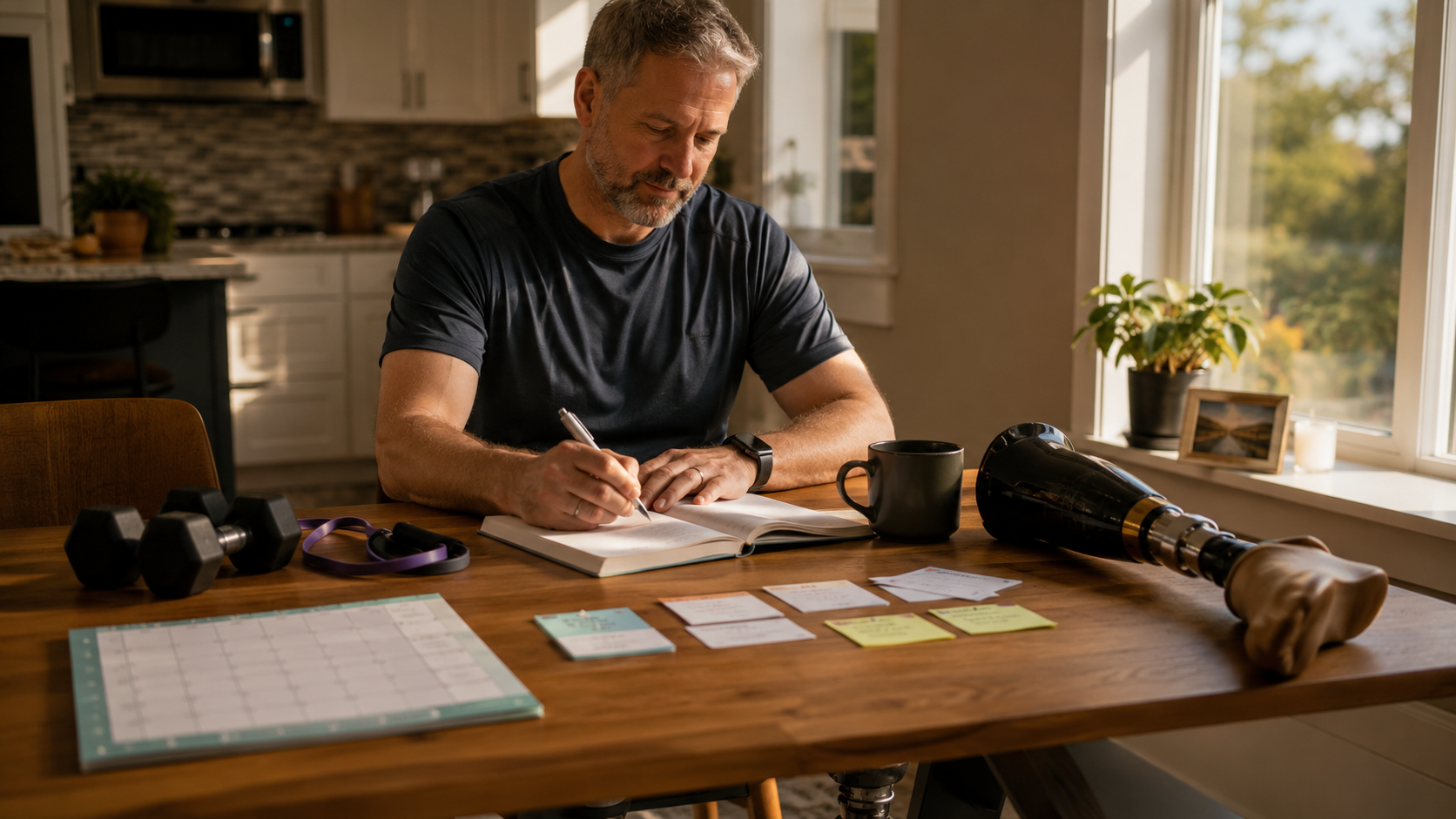
The First Year After Limb Loss: Why Every New Amputee Needs a Recovery Journal
Losing a limb changes far more than the way a person walks, reaches, or performs everyday tasks. It changes routines, confidence, relationships, expectations, and often a person's entire view of the future. The first year after limb loss is unlike any other season of life. It is filled with victories that few people notice, setbacks that others cannot see, and emotional highs and lows that can arrive without warning.
People who have never experienced limb loss often assume recovery follows a straight path. Surgery happens, wounds heal, a prosthetic is fitted, physical therapy begins, and life returns to normal.
Anyone living through that first year knows better.
Recovery is rarely a straight line.
Some mornings begin with confidence and determination. By afternoon, phantom pain, swelling, exhaustion, or frustration can make even the simplest task feel impossible. A great prosthetic appointment may be followed by days of soreness. Walking twenty extra feet can feel like winning a marathon, while the next day it may seem impossible to repeat.
This constant cycle of progress and setbacks can make it difficult to recognize how far you've actually come.
That is exactly why keeping a recovery journal can become one of the most valuable tools a new amputee owns.
A journal cannot eliminate pain.
It cannot speed healing.
It cannot replace a prosthetist, therapist, physician, or support network.
What it can do is preserve perspective.
Over time, those daily entries become proof that progress is happening—even when it doesn't feel like it.
The Emotional Roller Coaster Nobody Fully Explains
Every amputee experiences recovery differently, but nearly everyone encounters emotional challenges during the first year.
Grief often comes in unexpected waves.
Some people grieve immediately after surgery. Others don't begin processing the loss until months later when they return home, go back to work, or encounter activities they once took for granted.
Simple moments can become emotional.
Standing in front of a mirror.
Putting on a favorite pair of shoes that no longer fit.
Watching someone run across a parking lot.
Climbing stairs.
Driving again.
Seeing old photographs.
These moments can trigger sadness, anger, frustration, fear, or even guilt.
Many amputees feel pressure to remain positive all the time.
Friends and family celebrate milestones.
Medical staff applaud progress.
Social media often highlights inspirational recovery stories.
Yet behind closed doors, many new amputees quietly ask themselves difficult questions.
Will I ever feel normal again?
Will I always hurt?
Can I work again?
Can I enjoy hobbies again?
Will people see me differently?
Am I still the same person?
These questions are normal.
Writing them down removes some of their power.
Instead of allowing fear to circle endlessly in your thoughts, journaling gives those emotions somewhere to go.
Recovery Becomes a Full-Time Job
The first year after amputation often feels like holding a full-time job that nobody prepared you for.
Medical appointments begin to dominate your calendar.
Follow-up surgeries.
Physical therapy.
Occupational therapy.
Prosthetic evaluations.
Socket adjustments.
Shrinker fittings.
Insurance paperwork.
Transportation.
Medication management.
Each appointment introduces new information.
Some days you'll leave encouraged.
Other days you'll leave discouraged because something still doesn't fit correctly or healing is taking longer than expected.
Trying to remember every instruction weeks later becomes difficult.
A journal becomes a practical tool.
Write down:
- Questions for your next appointment.
- Socket pressure points.
- Medication changes.
- Therapist recommendations.
- Exercises that help.
- Activities that increase pain.
- Improvements you notice.
These records become incredibly valuable during future appointments.
Instead of trying to remember how you felt three weeks ago, you'll have accurate notes that help your care team understand what's actually happening.
Prosthetic Fittings Are a Journey, Not a Destination
One of the biggest surprises for many new amputees is discovering that receiving a prosthetic limb isn't the end of recovery.
It's actually the beginning of a new phase.
Residual limbs change constantly during the first year.
Swelling decreases.
Muscle changes.
Body weight fluctuates.
Scar tissue softens.
Volume changes throughout the day.
That means socket fit changes too.
A prosthesis that feels perfect one week may feel completely different the next.
Many new amputees become discouraged, believing something is wrong with them.
In reality, these changes are completely normal.
Keeping daily notes about socket comfort, walking time, pressure areas, liner issues, and activity levels helps identify patterns.
Over time, those patterns help both the amputee and prosthetist make better decisions.
Instead of relying on memory, you have real data.
Pain Changes More Than You Expect
Pain after limb loss isn't always predictable.
Phantom pain.
Phantom sensations.
Residual limb pain.
Muscle soreness.
Back pain.
Hip pain.
Shoulder fatigue.
Good days.
Bad days.
Many people become discouraged because pain seems random.
Often it isn't.
A journal can reveal connections you might otherwise miss.
Perhaps pain increases after poor sleep.
Maybe weather changes affect phantom sensations.
Certain foods may contribute to inflammation.
Walking longer distances may improve confidence but require additional recovery afterward.
Tracking these details helps transform recovery from guessing into learning.
Knowledge reduces fear.
Patterns create confidence.
Small Victories Are Easy to Forget
One of the greatest challenges during recovery is that improvements often happen so gradually they're almost invisible.
The first independent shower.
The first trip to the grocery store.
Walking without holding the rail.
Driving again.
Cooking dinner.
Standing long enough to wash dishes.
Taking the dog outside.
Returning to church.
Fishing.
Gardening.
Playing with grandchildren.
None of these moments make national headlines.
But each one represents a tremendous victory.
Without recording them, many amputees unintentionally focus only on what remains difficult.
Reading journal entries from three months earlier often becomes a remarkable experience.
"I couldn't stand for five minutes."
"I was afraid to leave the house."
"I couldn't put my liner on by myself."
"I needed help transferring."
Months later, those challenges may already be behind you.
Your journal reminds you just how much you've accomplished.
Journaling Creates Honest Conversations
Recovery sometimes becomes lonely.
Friends eventually stop asking how you're doing.
Family members assume things are improving.
Coworkers expect life to return to normal.
Meanwhile, you're still navigating physical and emotional challenges every day.
A journal becomes one place where complete honesty is always welcome.
You don't have to pretend.
You don't have to encourage anyone else.
You don't have to protect other people's feelings.
You can admit fear.
Celebrate victories.
Express anger.
Record gratitude.
Share hope.
Every emotion belongs.
Many people discover that writing honestly reduces emotional pressure they didn't even realize they were carrying.
Progress Isn't Always Physical
One misconception about recovery is that success is measured only by walking distance.
Physical progress matters.
But emotional growth matters just as much.
Learning patience.
Accepting help.
Building confidence.
Finding humor again.
Meeting another amputee.
Speaking openly about your experience.
Trying something new.
Helping someone else.
These milestones rarely appear in medical charts.
Yet they often define long-term recovery.
A journal captures those moments before they're forgotten.
Building a Habit of Gratitude
Gratitude doesn't erase hardship.
It changes perspective.
Some days gratitude may be simple.
"I slept better."
"My incision looks healthier."
"My prosthesis felt comfortable today."
"I laughed."
"My granddaughter hugged me."
"I walked farther."
"I watched the sunrise."
Recording one positive moment every day slowly retrains the mind to recognize progress alongside struggle.
This isn't forced optimism.
It's balanced perspective.
Both challenges and victories deserve space.
Looking Back Changes Everything
Many amputees become discouraged because they compare themselves to where they hope to be.
A journal encourages a healthier comparison.
Compare yourself to yesterday.
Compare yourself to last month.
Compare yourself to the day you left the hospital.
That comparison often tells a very different story.
Instead of seeing only remaining obstacles, you begin recognizing remarkable progress.
Recovery becomes visible.
Confidence grows.
Hope strengthens.
Why I Created 365 Days of Strength
As a bilateral below-knee amputee, I understand something that no textbook can fully explain.
Recovery doesn't happen one dramatic moment at a time.
It happens quietly.
One morning.
One appointment.
One difficult conversation.
One successful step.
One frustrating setback.
One unexpected victory.
Again and again.
When I began thinking about what newly amputated patients truly needed, I realized there wasn't enough emphasis on documenting the journey itself.
There were medical resources.
Exercise guides.
Equipment information.
Therapy appointments.
But there wasn't a daily companion that acknowledged both the physical and emotional realities of that first year.
That realization led me to create 365 Days of Strength.
It isn't simply a journal.
It is a guided companion designed specifically for first-year amputees.
Each day provides encouragement, reflection, and space to record the moments that matter.
Some days focus on resilience.
Others emphasize gratitude.
Some encourage patience.
Others simply remind you that surviving today is enough.
The goal isn't to create perfect days.
The goal is to remind you that every day matters.
When viewed individually, today's progress may seem small.
Viewed across an entire year, those small moments become a remarkable story of determination.
Your Story Is Still Being Written
Amputation changes life.
It does not end it.
There will be days that test your patience.
Days when pain feels overwhelming.
Days when progress seems to disappear.
There will also be days you'll surprise yourself.
Days when walking feels easier.
Days when laughter comes naturally again.
Days when you realize you've accomplished something that once seemed impossible.
Those moments deserve to be remembered.
Not because they're extraordinary to the rest of the world.
Because they're extraordinary to you.
Years from now, your journal may become more than a record of recovery.
It may become proof of your resilience.
Proof that you kept going.
Proof that healing wasn't perfect, but it was real.
Recovery is rarely measured in giant leaps.
More often, it's measured in thousands of small decisions to keep moving forward despite uncertainty.
Those decisions deserve to be recorded.
Because recovery is not measured by perfection.
It is measured by persistence.
And sometimes the most powerful reminder that you're making progress is simply reading the words you wrote when you thought you weren't.
Get you Journal today from Amazon