
Some crime novels begin with a question: Who did it?
The more unsettling ones ask something harder.
What remains after the crime is over?
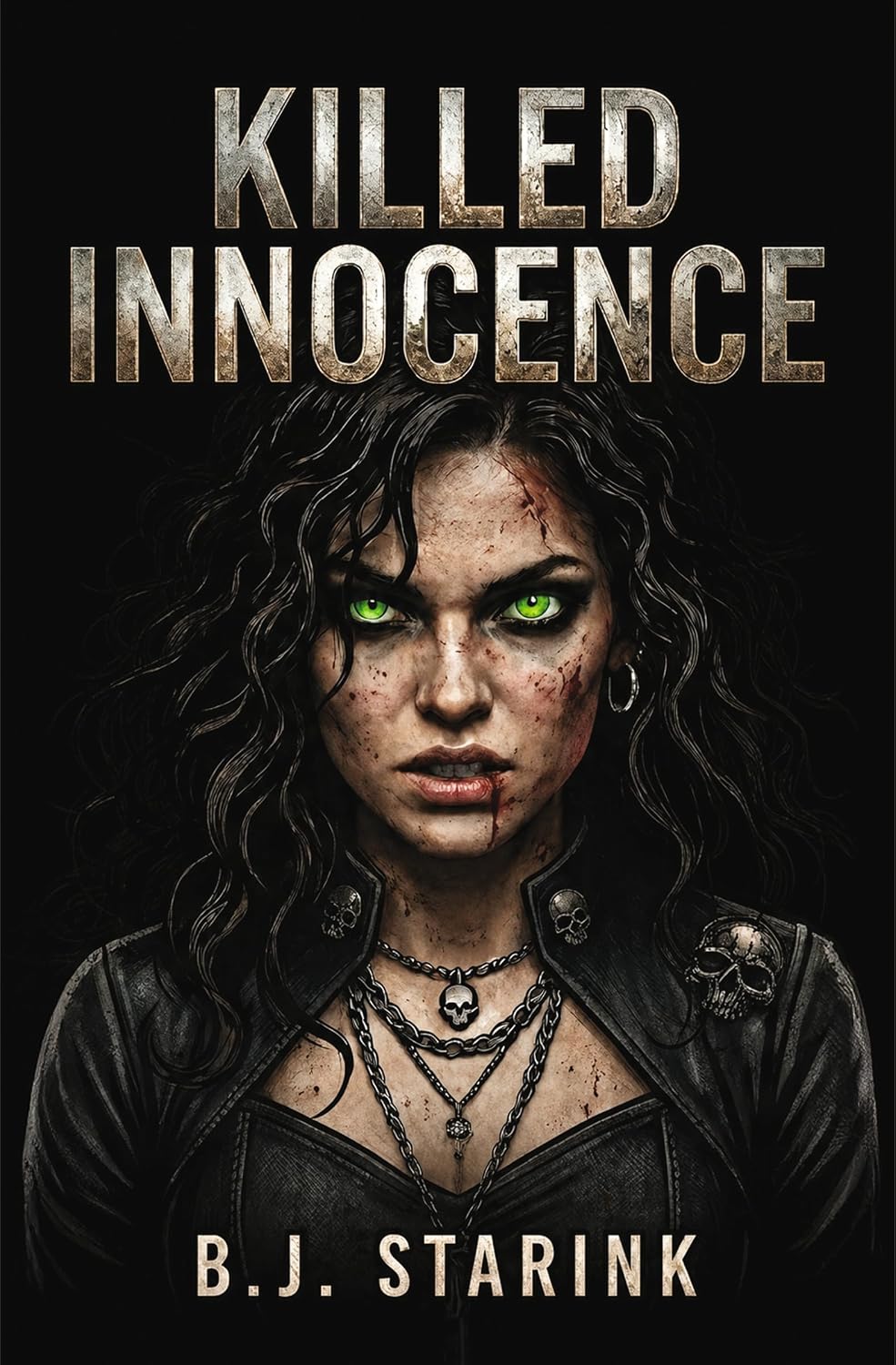
That is the territory surrounding Killed Innocence, the psychological crime thriller from Dutch author B.J. Starink. Rather than presenting violence as nothing more than the mechanism that starts a mystery, the book is positioned around consequences: trauma, betrayal, buried truths, moral uncertainty and the difficult search for justice after innocence has already been damaged.
It is a darker approach to the crime thriller, and one that fits naturally with an author who has spent much of his writing career exploring fear, psychological extremes and uncomfortable corners of human behavior.
The central promise is not simply suspense. It is confrontation.
A Thriller About What Violence Leaves Behind
The title Killed Innocence establishes its territory immediately. Innocence is not merely threatened. It has already been destroyed.
That distinction changes the emotional direction of the story. Instead of building everything around whether something terrible might happen, the novel begins from the understanding that harm carries consequences long after the original event.
According to the publisher description, violence, betrayal and hidden truths form the foundation of the story. Secrets begin to surface, and each revelation creates new questions rather than neatly resolving the ones that came before.
That is fertile ground for psychological crime fiction. The most effective stories in the genre rarely depend on a single revelation. They work because every answer changes the reader's understanding of the people involved. Motives become less certain. Victims may know more than expected. Those who appear trustworthy may be protecting something. Those who seem guilty may have histories that complicate easy judgment.
Justice becomes a process rather than a destination, and Killed Innocence is positioned squarely within that kind of moral uncertainty.
When the Truth Becomes Dangerous
One of the strongest ideas behind the novel is the suggestion that discovering the truth may create dangers of its own.
That is an important distinction from traditional mystery fiction. In a conventional puzzle mystery, the truth represents resolution. The detective gathers facts, exposes the guilty party and restores order.
Psychological crime fiction often refuses to offer that comfort.
Truth can destroy relationships. Truth can expose betrayal. Truth can force people to confront choices they spent years rationalizing. Truth can turn victims into witnesses, friends into suspects and carefully maintained lives into something impossible to preserve.
The result is a more personal form of suspense. The danger is not limited to whether someone will be physically harmed. It comes from wondering what another revelation will cost.
That emotional pressure is what allows a psychological thriller to stay with the reader after the immediate mystery has been resolved.
B.J. Starink Moves Through Dark Territory
Readers familiar with B.J. Starink may already associate his name with darker fiction.
The Dutch author has written across horror, psychological horror, fantasy and other genres, with adult books that frequently explore extreme situations, disturbed characters and fear-driven storytelling.
His catalog includes titles such as Unknown Tendencies, Homicidal Tendencies, Stormie! and Asmodil!. That history gives Killed Innocence an interesting position.
The novel is identified as a psychological crime thriller rather than simply horror, but Starink's background suggests readers should not expect a sanitized procedural. His darker fiction has repeatedly moved toward fear, damaged people and psychologically difficult territory.
That does not necessarily make Killed Innocence a conventional extreme-horror novel. It does suggest that the psychological crime story is coming from a writer already comfortable taking readers into unpleasant emotional territory.
For thriller readers who prefer stories with rough edges, that may be part of the appeal.
Crime Fiction Becomes Stronger When Justice Is Complicated
The word “justice” appears frequently in crime marketing, but the most interesting crime novels rarely treat justice as simple.
Finding the person responsible for an act is not always the same as repairing the damage. Punishment does not restore innocence. A confession does not erase trauma. A verdict cannot return time to the people whose lives changed.
That gap between legal resolution and emotional resolution gives psychological crime fiction much of its power.
Killed Innocence appears to lean into that tension. Its positioning describes morally complex characters and a story in which justice is not as straightforward as it first appears.
That matters because morality becomes far more interesting when characters cannot be divided neatly into heroes and villains. Human beings make compromises. They hide things. They protect people they love. They remain silent when speaking would cost them too much. They convince themselves that one wrong action was necessary because something worse might otherwise have happened.
A strong psychological thriller forces readers to examine those decisions rather than merely observe them. The question gradually shifts from “Who is guilty?” to “What would I have done?”
Resilience Gives the Darkness Meaning
A novel about murder, trauma and betrayal could easily become an exercise in bleakness. The inclusion of human resilience in the book's positioning gives the story another dimension.
Resilience does not mean that damaged people simply return to who they were before. That is rarely how trauma works.
Real resilience involves continuing while carrying knowledge that cannot be forgotten. It means rebuilding identity after trust has been broken. It means making decisions after certainty has disappeared.
In fiction, that creates a different kind of strength than the invulnerable action hero. A psychologically wounded character may hesitate, fail, retreat, become angry or make bad choices while still moving toward survival.
Those characters often feel more human because resilience is something they must continually choose. For readers, that creates an emotional stake larger than discovering the mechanics of a crime.
The reader wants to know whether someone can emerge from what happened without allowing the violence to define everything that follows.
That may be the most important question contained in a title like Killed Innocence. Innocence can be destroyed. The person who lost it does not necessarily have to be.
A Different Side of an Unusual Author Career
Starink's broader career also makes the book worth watching. His writing identity is unusually divided between very dark adult fiction and children's projects built around helping younger readers confront fear.
His Boogeyman Beater Club and related children's work turn frightening imagery into stories about children overcoming nightmares and fear of the dark. His adult books travel in almost the opposite direction.
Instead of making fear smaller, they examine what happens when people move deeper into it.
Yet those two bodies of work are not entirely unrelated. Both depend upon fear. Both deal with the psychological effects of frightening experiences. Both ask what people do when confronted by something that unsettles their understanding of themselves or their world.
Killed Innocence occupies the adult side of that equation, where fear is not something hiding under the bed but something embedded in human choices, violence, secrecy and memory.
Who Is Killed Innocence For?
This is not a book positioned for readers looking primarily for a light detective puzzle.
Its natural audience appears to be readers who enjoy psychological thrillers in which the emotional consequences matter as much as the mechanics of solving the crime.
This book may appeal to readers drawn to:
Dark crime fiction
Psychologically complicated characters
Stories about trauma and survival
Murder mysteries where motives matter
Morally ambiguous situations
Secrets that alter the meaning of earlier events
Suspense that crosses toward horror without abandoning the crime-thriller structure
Readers already familiar with Starink's darker catalog may find the crime-thriller framework a natural extension of his established interests. Those encountering him for the first time may find Killed Innocence a more accessible entry into his work than beginning with one of his explicitly horror-focused titles.
Book Details
Title: Killed Innocence
Author: B.J. Starink
Genre: Psychological Crime Thriller / Psychological Suspense
Key Themes: Trauma, buried secrets, betrayal, justice, moral complexity and human resilience
Availability: Major book retailers, including Amazon
More Than the Question of Who Did It
The enduring attraction of psychological crime fiction comes from something deeper than solving a mystery.
Crime creates a fracture. The thriller explores what people do inside that fracture.
Some seek truth. Some hide it. Some demand justice. Some fear what justice will expose. Some survive. Some discover that survival itself carries consequences.
Killed Innocence enters that territory with a title that already tells the reader something irreversible has happened.
The remaining question is not simply who caused it. It is what everyone touched by that destruction becomes afterward.
For readers who want crime fiction with psychological weight, morally complicated characters and a darker edge, B.J. Starink's Killed Innocence offers an invitation into a world where discovering the truth may only be the beginning.